Strategic HbA1c Testing to Reduce Readmissions in Diabetic Admissions

Updated: Jun 23, 2025
Preface
The following is the written version of a video and PowerPoint presentation I created, which explores the impact of HbA1c testing on hospital readmissions among diabetic patients. The content, analysis, and recommendations in this document mirror what is presented in the video but in includes the SQL code.
Or click the following link to view on YouTube:
Overview
Diabetes is one of the most prevalent and costly chronic health conditions, impacting millions globally and placing a significant burden on healthcare systems. My personal interest in this project stems from my passion for developing data-driven solutions that influence policy and decision-making, which in turn can lead to better health outcomes for those impacted. Preventing unnecessary hospital readmissions not only enhances patient outcomes, but also reduces strain on hospital resources as they navigate proper patient care.
This report investigates the relationship between HbA1c testing and hospital readmission rates among diabetic patients. The goal is to outline evidence-based policy recommendations on HbA1c testing as a readmission reduction strategy, particularly in cases where diabetes is a primary vs. secondary diagnosis.
Dataset Overview
Source: UCI Machine Learning Repository - Diabetes 130-US Hospitals for Years 1999-2008
Size: 101766 inpatient encounters
Field: Demographic information, diagnoses (ICD-9), procedures, lab test, medications, outcomes
Limitations:
Only the top 3 diagnosis codes available per encounter
Lacks exact test timing & patient-level clinical data
Research Questions
Is HbA1c testing associated with reduced readmission rates among diabetic patients?
Do outcomes differ depending on whether diabetes is the primary or secondary diagnosis?
Are the effects of HbA1c testing age-dependent (Do certain age groups benefit more from being tested)?
Can testing influence the timing of readmissions? (e.g., Within 30 days of release vs. after 30 days)?
Methodology & Analysis
Creating a Temporary Table
With our original dataset containing 50 columns of encounter information and this analysis being solely focused on the relationship between readmissions and HbA1c testing, I began by creating a temporary table within SQL containing all the relevant information we would need for this specific analysis. This process would allow us to write efficient queries without the need for constant filtering while also ensuring our results ran optimally.

Categorizing encounters
Primary Diagnosis: Diabetes in diag_1
Secondary Diagnosis: diabetes in diag_2, diag_3, or neither
Readmission Rates by Tested Status (All Diabetic Encounters)
We begin by taking a look at the readmission rates across all diabetic encounters, grouping by those who did and did not receive an HbA1c test during their encounter.

Key Findings
HbA1c-tested patients had a ~2.6% lower readmission rate than untested patients
Modest reduction, confounding factors are not adjusted
Readmission Rates by Age & Tested Status (All Diabetic Encounters)
I then wanted to analyze what the readmission rates were for the different age groups, with the goal to identify if a certain age group benefited more or less from being tested.

Key Findings
Readmission Rates are nearly identical between patients who were and were not tested on an age-group level
HbA1c test should be age-agnostic, as no group warrants testing prioritization based on age alone
Diabetes as the Primary Diagnosis
Now how does the readmission rate differ when the primary reason for the encounter is due to diabetes?
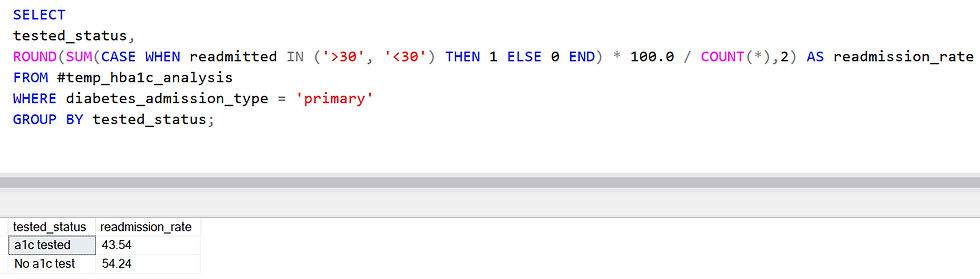
Key Findings
Among patients primarily admitted for diabetes, HbA1c testing led to a 10.7% reduction in readmissions
An ~11% decrease in readmissions suggests that testing may better help guide treatment, properly adjust medication, and allow for a more comprehensive follow-up
Diabetes as the Secondary Diagnosis
How do the previous results differ when looking at encounters where diabetes wasn't the primary reason?

Key Findings
A ~2% reduction suggests limited benefit from testing in these cases
Further emphasizes the previous insight that testing is impactful when diabetes is the primary reason for the encounter
Testing in these cases should be left to clinical judgement
Comparing Length of Readmission by Tested Status (Diabetes as the Primary Condition)
Now while the ideal outcome is no readmission at all, we would much prefer them to come after the critical 30-day mark than before. This is critical for both hospital benchmarks as well as a reflection of proper patient management.
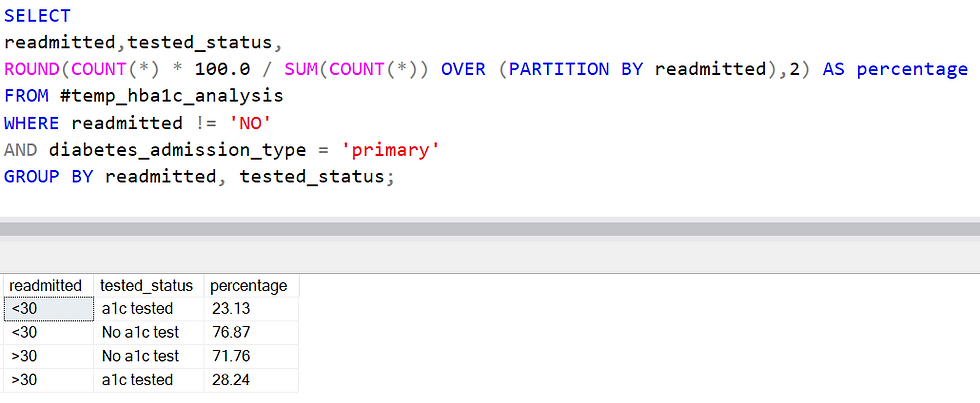
Key Findings
Findings suggest those who received a test were slightly more likely to be readmitted after 30 days rather than within 30, suggesting a potential delaying effect
While not preventing readmissions altogether, it appears to support improved short-term management, helping hospitals meet 30-day readmission targets
Limitations
HbA1c test timing is not captured (testing is not clinically appropriate in certain cases, such as if the patient has taken one recently)
Observational data, cannot infer causality
Recommendations
Mandate HbA1c testing for encounters where diabetes is the primary diagnosis
Use clinical judgement to assess the primary diagnosis, such as if a patient presents symptoms including uncontrolled blood sugar, diabetic ketoacidosis, hyperglycemia, or other related complications. Patients with these symptoms are more than likely to have diabetes as the primary reason for the encounter
Do not prioritize based on age as testing impact is consistent across all age groups
Optional testing for secondary diagnosis due to marginal benefits
Utilizing testing to push readmissions beyond the 30-day mark, improving hospital metrics and ensuring proper management of patient care once discharged


Comments